Filthy Motorsports offers free spring exchanges with all new coilover orders.
(A)
Useable Wheel Travel is the total vertical distance that the suspension allows your wheels to move without binding. If the lower coilover mount is welded to the axle, then this measurement is that same as the shock stroke.
(B)
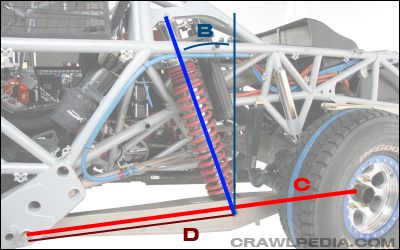
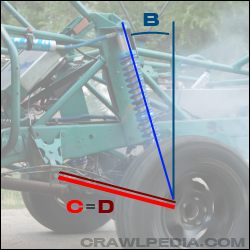
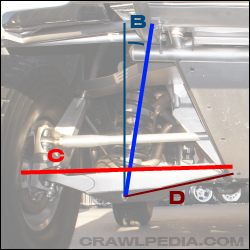
Coilover Angle is the angle at which the coilover is mounted, measured in degrees from absolute vertical in any direction.
(C)
Lower Arm Length is the length of the lower A-arm, trailing arm, or 4-link bar measured from the frame pivot to the wheel center.
(D)
Shock Mount Distance is the measurement from the frame side pivot of the lower link to the lower coilover mounting point. If the lower coilover mount is welded to the axle, then this measurement is equal to the lower arm length.
(E)
Sitting Droop Ratio is the percentage of the shock shaft positioned inside the shock body at ride height. (For example, if you want 6" of shaft showing at ride height on a 14" coilover, that's 8" of shaft inside the shock: 8/14 = 57%)
(F)
Corner Sprung Weight is the total weight supported by the coilover. Sprung weight does not include axle or wheel weights.
Dual Rate Spring Calculation Guide
Performance off-road coilover shocks are designed to have two different springs installed on them such that the vehicle transitions from a softer combined spring rate to the stiffer lower spring at some point during the compression stroke. For 8" and smaller coilovers, there might only be space for a single spring while 16" and 18" coilovers may require a third "tender" spring to prevent the springs from going loose at full extension.
In a dual rate coilover setup, the upper primary spring is placed on top of the secondary spring which is either the same rate or heavier than the primary spring. During the initial stroke, the two springs will compress together to give you a lighter combined rate (see table below) for the initial up stroke until the slider hits the transition nuts (secondary nuts) at which pint the upper spring is taken out of the equation and all remaining up travel is transferred to the lower secondary spring.
For dual rate coilovers you will need to multiply the spring rate calculated above by two to get the required spring rates. While running the same spring top and bottom will still give you a transition, we recommend (if possible) a 50 lb. heavier lower spring in the 100 to 300 lb. range and a 100 lb. heaver spring for spring rates 400 lb. and above for a more significant transition. The lower spring, in general, should never be more than 150 lbs. heavier than the top spring.
Effective Primary Spring Rate In A Dual Rate Configuration
Rate
100
150
200
250
300
350
400
450
500
100
50
150
60
75
200
67
86
100
250
71
94
111
125
300
75
100
120
136
150
350
78
105
127
146
162
175
400
80
109
133
154
171
187
200
450
113
138
161
180
196
212
225
500
143
167
188
206
222
237
225
Combined effective coilover spring rate listed in lbs./in.
Triple Rate / Tender Springs / Helper Springs
Tender springs, also known as helper springs, are used in applications were the primary springs don't allow the coilover to settle down low enough under the weight of the vehicle to reach the desired ride height. This happens most often with long travel coilovers in applications with a relatively low ride height. Tender springs are low rate (50 to 90 lbs./in.), short (3" to 5"), and often made with flat wire. They remain compressed under load until the other springs fully extend at which point the helper spring expands keeping a load on the springs to prevent them from going loose.
Video: Coilover Springs, Spring Rates, and Calculations
Shock Rebuild Instructions - Detailed step-by-step instructions for rebuilding high-performance shocks. Shock Rebuilding Tools - A list of tools needed to service high-performance shocks and coilovers. Shock Valving Guide - A guide to high-performance shock valving and valving shim configurations. Shock Tuning Guide - A guide to how high-performance shocks are tuned and valved to work well. Shock Valving Shim Stack Examples - A list of common, basic valving shim stack configurations for high-performance shocks. 4-Link Suspension Guide - A quick overview of the most important elements of 4-link geometry. Shock Rebuild Parts - A link to Filthy Motorsports' shock parts page. How To Measure For Coilovers - Order the right size shocks and coilovers by following these detailed instructions. Coilover Install and Setup Guide - Proper coilover installation, setup, and fine tuning instructions. Coilover Spring Re-Calculation Guide - How to easily correct coilover spring rates to achieve your desired ride height. ORI STX Struts Guide - An introduction to ORI STX Struts, how they work and how to tune them. Hydraulic Bump Stop Guide - A detailed overview of hydraulic bump stops and jounce shocks for off-road use.
Filthy Motorsports
High performance off-road racing parts and professional shock tuning. Learn more at FilthyMotorsports.com
Shock Service, LLC
Professional shock tuning and rebuilding services for King and ADS shocks. Learn more at ShockService.com
Polar Cryogenics
Cryogenic treatment improves strength and longevity of gears, axle, and brakes. Learn more at PolarCryogenics.com
Crown Race Gears
Race-spec ring and pinion gears for desert racing, rock bouncing, and rock crawling. Learn more at RaceGears.com
This website uses cookies or similar technologies to enhance your browsing experience. By continuing to use our website, you agree to our Privacy Policy